
Major telecommunications firm
Deployed Alcatraz facial authentication with both single- and two-factor support across employees, contractors, and visiting executives.
Telecommunications
Central offices, switch sites, and cell huts — verified, badge-free entry across thousands of distributed locations.
Opt-in enrollment · Badge fallback stays · Works with Genetec, LenelS2, C•CURE, and Genea
The Problem
Central offices, huts, and shelters operate unstaffed by design. Every one is an entry point to the network, and a badge reader alone can't say who is actually at the door.
Tower crews, fiber contractors, and vendor techs rotate constantly across regions. Keys and shared codes outlive engagements; access rarely matches the current roster.
Copper, batteries, and equipment disappear from exactly the locations no one watches. After an incident, the first question — who was there? — usually has no good answer.
Carrier compliance programs and enterprise customers increasingly ask for per-person access records at network facilities. Assembling them from key logs and gate codes is guesswork.
Provisioning, replacing, and recovering physical credentials across a multi-state footprint is a permanent logistics tax — and the network keeps growing.
The Solution
Facial authentication at the edge, tailgating detection, and enrollment with recorded consent — delivered through the access control system you already run.
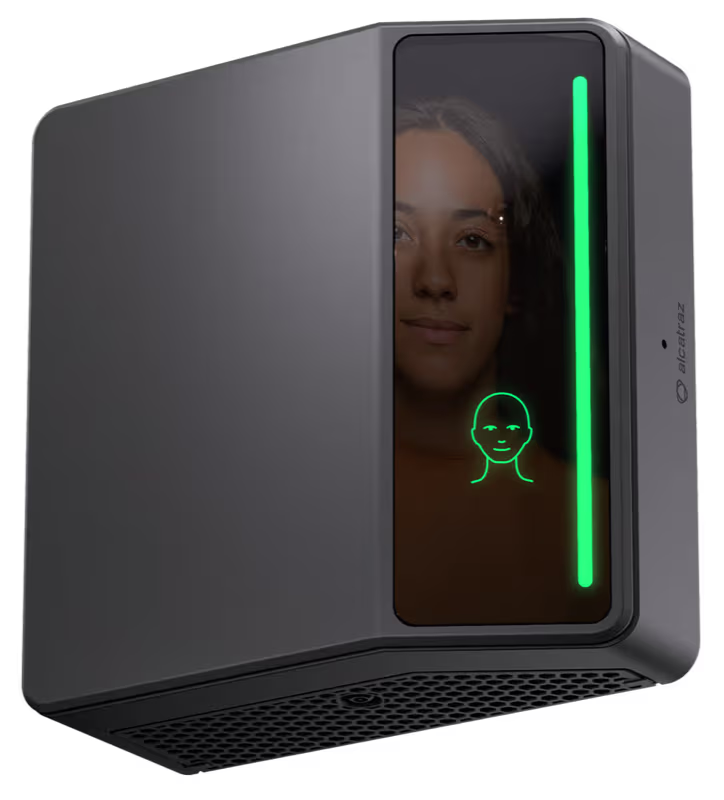
Rock X is IP66 and IK08 rated and operates from -40°F to 150°F, darkness to 120,000 lux — shelter doors, compound gates, and rooftop sites included.
A 3D, liveness-checked authentication happens on the reader itself — a verified person at every unstaffed door, with no guard and no shared code.
Crews enroll from a phone in about a minute; revocation deletes the template immediately when the engagement ends. Access tracks people, not keys.
Two-factor authentication protects the rooms where an outage becomes regional news, with tailgating detection watching the threshold.
The Alcatraz Platform manages devices, enrollment, consent, and per-person audit records across the whole estate — cloud or on-premises — over standard Wiegand/OSDP integration.
In Production
5M+ employees protected and a 95% customer satisfaction rating, as of the April 2026 Series B announcement.
Major telecommunications firm
Deployed Alcatraz facial authentication with both single- and two-factor support across employees, contractors, and visiting executives.
Adjacent critical-infrastructure operators
Power system operators and pipeline companies run the same distributed-site playbook — outdoor-rated readers, contractor enrollment, and per-person audit records across multi-state footprints.
[NEEDS CLIENT INPUT]
Additional telecom-specific proof points pending client confirmation — alcatraz.ai publishes no dedicated telecommunications case study.
How It Works
People opt in from a phone or laptop in about a minute. Consent is recorded, auditable, and revocable in the Alcatraz Platform.
A 3D, liveness-checked facial authentication happens at the edge — on the device — in under a second. Nothing to find, share, or clone.
Rock X presents to your access control system as a standard reader over Wiegand or OSDP. Panels, policies, and badge fallback stay put.
FAQ
Yes — it is built for doors with nobody behind them. The authentication decision happens on the device itself: a 3D, liveness-checked verification that a printed photo or phone screen cannot fool. Every entry at a hut, shelter, or central office becomes a named, logged person.
Crews self-enroll from a phone in about a minute with recorded consent, and revocation is immediate — the template is deleted the day the engagement ends. That replaces the shared gate codes and unreturned keys that make contractor access the weakest link at distributed sites.
Yes. Rock X is rated IP66 against weather and IK08 against impact, operating from -40°F to 150°F and from darkness to 120,000 lux. Compound gates, shelter doors, and rooftop installations are standard mounting positions, with no shelter or enclosure required.
The access record finally answers the first question investigators ask. Every entry is a verified person with a timestamp — and tailgating detection flags anyone who followed an authorized entrant in. That evidence trail is also what insurers and enterprise customers increasingly want to see.
Yes. Rock X presents as a standard reader over Wiegand or OSDP to Genetec, LenelS2, Software House C•CURE, and Genea — panels, gate hardware, and monitoring stay as they are. Sites roll over one at a time, with badge fallback throughout.
A 30-minute working session with an access control engineer — bring your doors, your ACS, and your questions.


