
International agency, Latin America
Deployed contactless facial authentication for employees — and established the reference design for the agency's future facilities across the region.
Government
Zero-trust physical access for government facilities — tiered authentication from the lobby to the evidence room, auditable end to end.
Opt-in enrollment · Badge fallback stays · Works with Genetec, LenelS2, C•CURE, and Genea
The Problem
The rooms that decide court cases demand per-person entry records. A badge event names a card; a defense attorney will ask who was holding it.
Cleared and escorted populations change daily. Credential provisioning that lags reality leaves access active after departure and missing on day one.
Even staffed lobbies can't watch every interior door. The sensitive spaces deeper in the building need their own enforcement, not a sightline.
FIPS 201-3 credentialing, CJIS and FISMA obligations, records-retention rules — government access control lives inside frameworks that vendors must fit, not fight.
Unions, counsel, and the public records process will all examine a biometric deployment. Opt-in consent and provable data minimization are the difference between adoption and headlines.
The Solution
Facial authentication at the edge, tailgating detection, and enrollment with recorded consent — delivered through the access control system you already run.
Single-factor face at general areas, face-plus-badge at sensitive zones — one platform enforcing the right level at every door, from lobby to evidence room.
Built-in video capture and real-time tailgating events give weapons rooms, evidence storage, and secure suites a record of what actually happened at the threshold.
The Alcatraz Platform runs in the cloud or entirely on-premises for environments where enrollment and audit data must stay inside the perimeter.
Opt-in consent recorded and revocable, encrypted non-reconstitutable templates, edge processing, no photos or videos stored on the device — claims your counsel can verify.
Wiegand and OSDP integration with Genetec, LenelS2, Software House C•CURE, and Genea keeps existing panels, PIV workflows, and alarm systems in charge of the doors.
In Production
5M+ employees protected and a 95% customer satisfaction rating, as of the April 2026 Series B announcement.
International agency, Latin America
Deployed contactless facial authentication for employees — and established the reference design for the agency's future facilities across the region.
Large U.S. law-enforcement agency
Secured its new headquarters with single-factor authentication in general areas and two-factor at sensitive zones — with video capture and tailgating detection protecting weapons and evidence rooms.
Technology enterprise in regulated facilities
Scaled the platform across regulated facilities supporting more than 150,000 employees with high-availability biometric access.
How It Works
People opt in from a phone or laptop in about a minute. Consent is recorded, auditable, and revocable in the Alcatraz Platform.
A 3D, liveness-checked facial authentication happens at the edge — on the device — in under a second. Nothing to find, share, or clone.
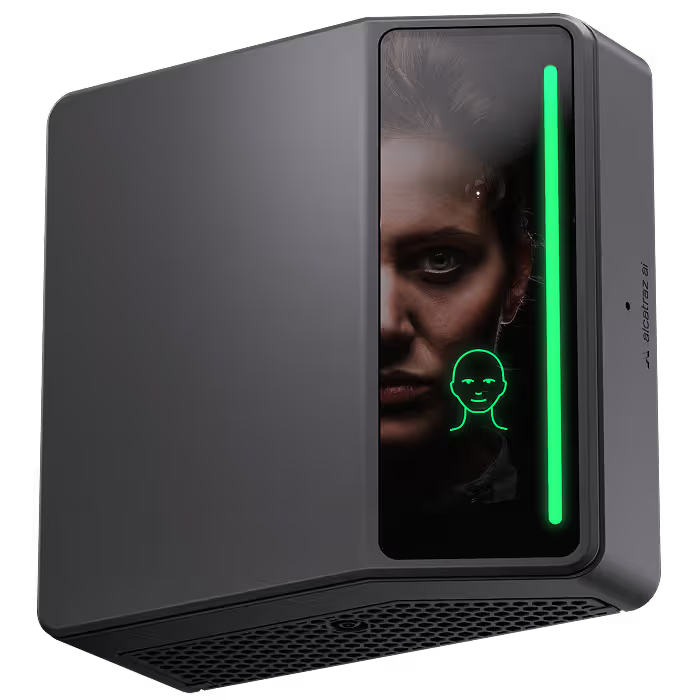
Rock X presents to your access control system as a standard reader over Wiegand or OSDP. Panels, policies, and badge fallback stay put.
FAQ
Yes — this is a proven deployment pattern. Face-plus-badge two-factor gives per-person accountability at the door, built-in video capture records the threshold, and tailgating detection flags anyone entering on someone else's authorization. A large U.S. law-enforcement agency runs exactly this configuration at its headquarters.
Yes. The Alcatraz Platform deploys entirely on-premises where policy requires enrollment data, consent records, and audit logs to remain inside the agency perimeter — with the same device management and reporting as the cloud model. Authentication itself always happens at the edge, on the reader.
The PIV credential stays the credential of record: Rock X presents as a standard reader to your access control system and adds face verification as an additional factor at the door. Existing FIPS 201-3 issuance, lifecycle, and PACS registration workflows continue unchanged — verification strengthens the door without touching the credential program.
Enrollment is opt-in with recorded, revocable consent. A 3D scan becomes an encrypted, non-reconstitutable template matched on the device — no photos, names, or videos are stored on it, with AES-256 at rest and TLS 1.2/1.3 in transit. Nobody who hasn't enrolled is ever matched against anything.
Yes. Contractors enroll the same opt-in way as staff — about a minute from a phone — and revocation deletes the template immediately when an engagement ends. Escorted visitors simply remain on existing badge and escort procedures; facial authentication never applies to anyone unenrolled.
Yes. Rock X speaks standard Wiegand and OSDP to Genetec, LenelS2, Software House C•CURE, and Genea, so panels, door hardware, schedules, and alarm logic stay exactly where they are. Rollout proceeds door-by-door on the agency's schedule, with badge fallback available throughout for anyone not yet enrolled.
A 30-minute working session with an access control engineer — bring your doors, your ACS, and your questions.


