
Major biopharmaceutical company
Deployed frictionless facial authentication across executive suites and turnstiles, hardening security ahead of a large-scale laboratory expansion.
Healthcare
Protect patient floors, pharmacies, and labs without slowing care — hands-free facial authentication that keeps clinicians moving.
Opt-in enrollment · Badge fallback stays · Works with Genetec, LenelS2, C•CURE, and Genea
The Problem
A shared credential at a med room or records office is invisible in the log — until an incident review asks who was actually in the room, and the badge data can't say.
Controlled-substance areas need per-person accountability, not per-card. Diversion investigations live or die on knowing exactly who opened the door, every time.
Fingerprint readers mean gloves off, gel on, queue up — friction and a hygiene objection at every door. Legacy readers that fail under real clinical use get propped open.
Behavioral health units, NICUs, and labs are exactly where a polite held door is most dangerous. Staff shouldn't have to be the enforcement mechanism.
Hospitals, clinics, and labs each carry their own audit surface. Assembling who-accessed-what evidence across facilities consumes security-team weeks every survey cycle.
Hundreds of clinicians move through staff entrances in minutes, three times a day. Any reader that adds seconds per person adds queues — and workarounds.
The Solution
Facial authentication at the edge, tailgating detection, and enrollment with recorded consent — delivered through the access control system you already run.
Clinicians authenticate with a glance — gloves on, hands full, PPE workflow intact. Sub-second verification keeps shift change moving.
Pharmacies, med rooms, records storage, and data closets get a second factor that can't be borrowed — the badge alone stops being enough.
The reader keeps watching after the unlock and raises real-time events when more people enter than authenticated — protection for the units where it matters most.
The Alcatraz Platform holds per-person entry records and consent documentation across every facility — ready for HIPAA-driven security reviews and accreditation surveys.
Standard reader over Wiegand or OSDP to Genetec, LenelS2, Software House C•CURE, and Genea — your panels, schedules, and badge fallback stay put.
In Production
5M+ employees protected and a 95% customer satisfaction rating, as of the April 2026 Series B announcement.
Major biopharmaceutical company
Deployed frictionless facial authentication across executive suites and turnstiles, hardening security ahead of a large-scale laboratory expansion.
Global medical technology company
Rolled out across a 75,000-employee global footprint, adding two-factor authentication and tailgating detection at high-security areas.
Healthcare IT leader
Replaced failing legacy biometric readers in its data centers, pairing facial authentication with existing badge readers for two-factor entry and tailgating detection.
How It Works
People opt in from a phone or laptop in about a minute. Consent is recorded, auditable, and revocable in the Alcatraz Platform.
A 3D, liveness-checked facial authentication happens at the edge — on the device — in under a second. Nothing to find, share, or clone.
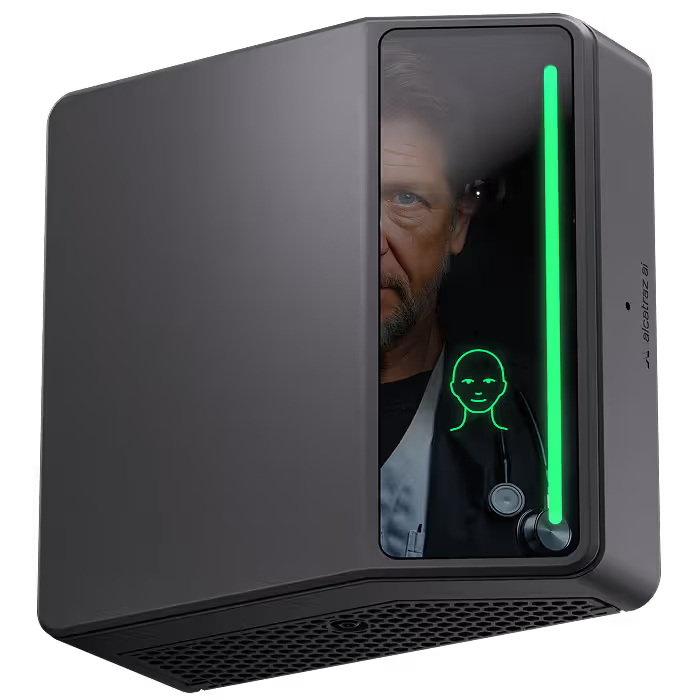
Rock X presents to your access control system as a standard reader over Wiegand or OSDP. Panels, policies, and badge fallback stay put.
FAQ
An enrolled clinician walks up to a protected door and is verified in under a second by a 3D, liveness-checked scan processed on the device — touchless, with gloves on and hands full. The reader passes a standard credential to your existing access control system, so every door keeps its current policies.
It supports the physical-safeguard side of a HIPAA program: per-person entry records for areas containing PHI, multi-factor authentication at records and server rooms, and audit documentation assembled from the Alcatraz Platform. Biometric data itself is minimized — encrypted templates at the edge, no photos or videos stored on the device.
Yes — authentication is fully touchless. Unlike fingerprint readers, there is no shared surface to disinfect and no gloves-off step in the workflow. Clinicians simply walk up and are verified at walking pace, which is why touch-free operation is one of the most cited reasons healthcare teams replace legacy biometrics.
Yes. Pairing face with badge gives controlled-substance areas true per-person, two-factor accountability — a borrowed badge no longer opens the door. Tailgating detection adds a second layer: if anyone follows an authorized person in, your access control system receives a real-time event tied to that door.
Enrollment is opt-in: a 3D scan becomes an encrypted, non-reconstitutable template, matched at the edge on the device. No photos, names, or videos are stored on it, data is AES-256 encrypted at rest and TLS 1.2/1.3 in transit, and any staff member can revoke consent and delete their template at any time.
Yes. Rock X presents as a standard reader over Wiegand or OSDP to Genetec, LenelS2, Software House C•CURE, and Genea. Badge fallback remains for staff who don't enroll, and your panels, door hardware, and schedules stay exactly as they are.
A 30-minute working session with an access control engineer — bring your doors, your ACS, and your questions.


